Tuesday, May 15, 2018

Progress: #7. take guitar lessons

I'm realizing that I am running short timelines for what is left of this list (and, as per usual, I'm more so itching to get the next set of 3 year goals started), so I've been considering what can reasonably be accomplished.

I am quite terrified of interacting with strangers -- though, yes, I am aware that everyone I now know was once one. I am not sure if my apprehension intensifies with age, or it just gets easier to opt out: (a) I socialize enough AT WORK to not want to have to otherwise, and (b) I gots my people already.

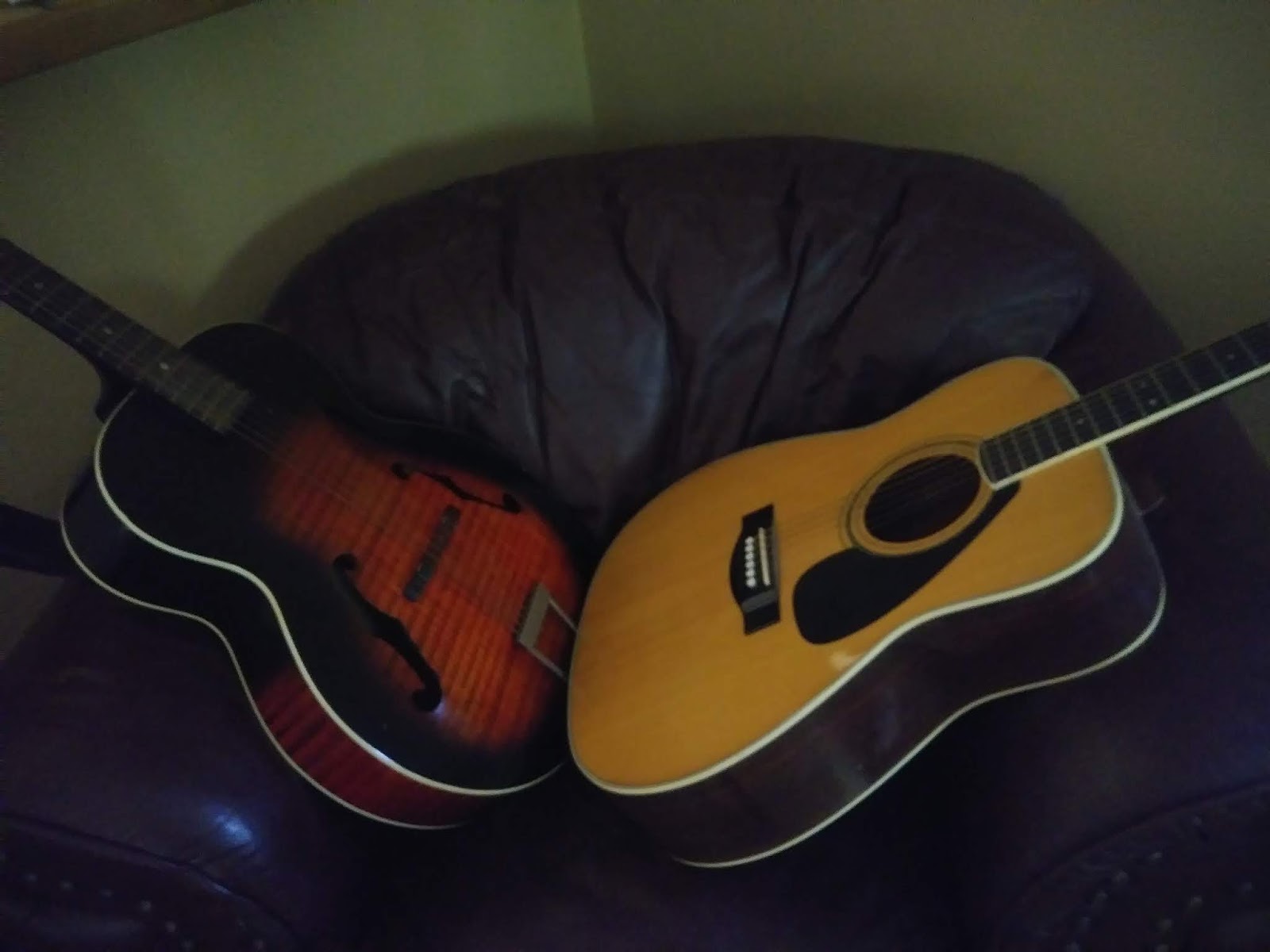
I got to thinking I was sure, therefore, that I'd retire this goal, or carry it over indefinitely (and perhaps purposelessly). It seemed a shame, though. This guitar (on the left, that looks like a giant violin,) is both beautiful and one of my only heirlooms from my dear grandpa. He also made the leather holding strap, with the pony buckle, by hand. Also, I love music, so much. 


Therefore, I asked my friend and work colleague - whom I obviously already know - Andy (of the band Wooden Bridge) if he could give me lessons. He agreed. We are starting tomorrow, continuing weekly until the school year ends.

(The right-hand guitar is my mother's heirloom, with a smaller neck. In typical MY MOM fashion she said, learning of these lessons: "Take it too! Maybe it will be easier to use!" I know nothing.)

Andy asked for a list of songs I'd like to learn. I ran through my music library, jotting possibilities into a word file. I realized that I don't think I've paid much attention to guitar much before, except to think that I like it best in folk and old country songs.

He said this one, of my choices, probably has the easiest chords. It's one of my favourite childhood country songs, soundtrack to a dark highway Gaspé road trip drive:


Original goal list posted here


Saturday, April 21, 2018

Progress: #17. propose exhibition of Métis identity

I'll be submitting the following three artworks, with accompanying biography, context, prices, and application to this on Monday.


PAINTING CONTEXT


1. “Woman Changing into Eagle.” Acrylic on canvas. June 11, 2014.
On May 17, 2014, I visited Manitoban Traditional Healer / Elder Colin Mousseau at Anishnawbe Health, who told me he saw a grandmother in a vision who said I was her relative. He said to my father, mother, and myself: “You have the blood in you. It’s obvious.” He spoke of my former sickness, of the recurring dreams of flying. He said I am “Wabano Ginew”, or Eastern Golden Eagle.
I feel honoured to have a spirit that is one of the most powerful in the skyworld. East, he said, is where the sun rises. This is also where all my connections lie.
On June 11, 2014, I painted “Woman Changing Into Eagle,” to mark the name: a not-so-subtle nod to Norval Morrisseau’s “Man Changing into Thunderbird” series, and a re-articulation of one of my favourite self-portraits from 2006.
The most significant moment regarding “wabano” – that ephemeral time between night and day – that I remember in my lifetime was the wee hour bus ride from the airport to a hotel in Jerusalem in 2011. Oh, the city shone like gold! I wish I could package that beauty to share with you. The background in “Woman Changing into Eagle” is a pictorial representation.


2. “How I Learned to Fly.” Acrylic on canvas. September 30, 2014.
All of the jewelry that I wear means something. I believe in clothing and adornments as a mode of communication, in addition to functionality. If I keep it to myself, it means something only to me. I am sometimes okay with this. However, 2014 was a year of substantial growth – my 30th on this planet – so I decided to mark these subtle communications to a painting.
My centre left-hand ring is from Kitigan. It is a site run by a Native Friendship Centre-based organization where my cousin works in downtown Toronto. Kitigan solicits arts and crafts from Northern indigenous communities, which are very far from artistic centres and gives them an online urban forum in which to sell their work. This ring is a medicine wheel, which has become one of the guiding forces and philosophies in my life.
My centre right-hand ring is from a mother of one of my high school students from the 2014/2015 school year. She scheduled a meeting with me by email, only to show up at my office door in tears, thanking me for “teaching her ‘black-and-white’ daughter to ‘see the greys’”. I laughed, as this was something my own mother often chided me, when I was younger, for being unable to do. This beaded ring was a gift of thanks. She bought it from indigenous artisans during her travels in South America.
My thumb ring, consisting of interlocking puzzle pieces, was purchased for autism awareness. After many years of social and emotional struggles, I was diagnosed with an Autism Spectrum Disorder in 2014. This knowledge changed my perception of myself and the world – and so it was something I wanted to note, in subtle adornment.
I am grateful for having noted the ephemeral nature of these pieces of jewelry in acrylic. Less than a year after painting, the beads of my centre right-hand ring began to unravel and I could no longer wear it. My thumb ring, a size too big, I lost to the cold the following winter. I now wear my medicine wheel ring on my right hand. I have purchased a smaller replacement puzzle piece ring.
The hands are meant to appear like wings, replicated much like children make shadow puppets. This was a year I learned to fly.


3. “Eagle Birch Burn.” Wood Burn on Birch, backed by Decoupaged Recyled Paper. January 3, 2018.
    In late 2016, I established Treecycle Toronto, after feeling horribly guilty that my first “real” Christmas tree had sacrificed its life to stand in the midst of my living room. Treecycle operated on an indigenous philosophy of conservation, and turned previously-loved Christmas trees into new housewares, art, ornaments, and jewelry. Ever since, my uncle has been quite passionate about the ways in which he can contribute to my environmental conservation efforts.
    This is how I came to inherit many scrolls of shorn birch bark that he found at a great uncle’s cabin. At first they simply sat in my art studio, because I was unsure what to do with them. Around the same time, I inherited the gift of a wood burner. By the new year, 2018, I was itching for a new art and decided to give the wood burner a try.
    This is my first wood burn. I recently read an article that the hobbies of our ancestors can be written to our DNA. My ancestors have oft been woodworkers.


Original goal list posted here

Thursday, March 15, 2018

Completed: 30/30 - #18. read 30 texts that will aid in my teaching


I meant to do more with my March Break. After all, three of three years on this list are wrapping up in less than half a year and I still have goals to accomplish!

However, I found this book. Five days after cracking the cover, I'm still sitting here, my face wet with tears from what - Geoff can verify - is a book that has actually also made me laugh aloud more than any I have ever read.

I haven't sincerely ENJOYED reading something this much in almost a decade.

Oh, the students? I can add it to the 2D multicultural ISU list (Swedish), or watch the film and have the 3Us run a comparison.

I don't know. I'm not feeling all that intellectual right now. I'm just feeling.


Original goal list posted here

Sunday, March 4, 2018

Completed: #15. do my own taxes

I used Simple Tax to do my own taxes for the first time, like a real adult.

The wailing like a baby from fear and frustration? Not quite like a real adult yet. Maybe next year.

Alas. I prevailed. One more goal achieved. 


Original goal list posted here.

Monday, February 26, 2018

Progress: 27/30, 28/30, 29/30 - #18. read 30 texts that will aid in my teaching


I had the good fortune to teach Writer's Craft this past semester, which was one of my main motivations for wanting to teach in the first place. I've kept some running Quick Note files in my phone of the curriculum guidelines since August's end, highlighting and marking them up with ideas for lessons and summatives. The very cool part of teaching this single-section course for the foreseeable future is that I had the liberty to aggregate all resources and eventually decide the trajectory on my own. In this way, I wasn't inheriting someone else's course, but crafting it in a way that made absolute sense to me and wherein I could be certain that I was meeting all curricular expectations.

In order to catch some analytical skills that may otherwise not be accessed in other summative assignments, I included an independent study of a Canadian author, where students were required to study at least two different forms of text (i.e. poetry and a novel) by the same author, and make an analytical claim based on those chosen texts in tandem with biographical material.

I compiled a list of about 35 authors I had read, as I always find it easier to assist and to mark when I am familiar with the material. Owing to both personal investment and our 2D multicultural ISU, this inevitably contained quite a few indigenous Canadian authors. I made it a silent goal to chip away at more forms from authors who were known to me.


The first I was lent by a colleague (Hi, Imman!). It is a play by an author from whom I had only read one short story previously -- "A Blurry Image on the Six O'Clock News" (Drew Hayden Taylor). Taylor, half-Ojibway and half-Caucasian, blonde-haired and blue-eyed, but raised very traditionally, calls himself "a memorable Occasion". I saw him speak once at a Peel schools event. I did not know what to make of his humour and absence of niceties. This man does not mince words. I read his play AlterNatives on my December break, while incapacitated with the worst flu I've had in ten years. I had budgeted time for a crafting frenzy, but I was horizontal by necessity for four days. I had to keep my mind engaged. I bore easily.

I read the foreward, in which he wrote: "While writing this play, I was fully expecting to become the Salman Rushdie of the Native community, for I'm sure there is something in this play to annoy everybody." The rest followed suit. If I don't appreciate Drew Hayden Taylor's sense of humour fully - well, at the very least, I better understand it now.


The second, Thomas King's CBC Massey Lectures The Truth About Stories, I started immediately afterwards, but did not complete until just recently. I was propelled into a reporting cycle crunch and had to take a break.

What a narrative. Eternally quotable. It made me feel and think and write. Previously I had only read "I'm Not The Indian You Had In Mind". I was sure then I'd appreciate King, but waited quite some time to browse another form of his writing.

I was taken by a great deal of excerpts, but this quote meant especial much to me:

"For the reality of identity legislation has not simply been to erase Indians from the political map of North America, it has also had the unforgivable consequence of setting Native against Native, destroying our ability and desire to associate with each other. This has been the true tragedy, the creation of legal categories that have made us our own enemy."

Now, I am an "Eastern Métis". I descend, on the side of 3/4 grandparents, from Mi'kmaq and European heritage via the Gaspé coast of Quebec. I belong to The Métis Nation of the Rising Sun (<-- translation), as well as interact within many groups of Eastern Métis.

For the record, the word "métis" itself is a French creation, meaning "mixed blood". The iconic sash is also a Quebec creation. The east was the point of first contact before our people moved west with the fur trade.

I tell you this because there is a troubling divisiveness in the community. Red River Métis such as writer and intellectual Chelsea Vowel make claims that the Eastern Métis are not real - that, with regard to our identity, we are "self-indigenizing" and should "get over it". I worry, because her book Indigenous Writes is in our school system and sometimes given to educators and administrators -- and people without real critical awareness listen to words of dissent. I am pleased that there are Red River Métis such as David Bouchard who push back against those voices, but I worry that it is not enough.

I know who I am and I know what customs are the product of a fusion of cultures. I am proud to be of the generation where we can reclaim what was lost due to fear and racism. I don't want to be shamed into hiding again.

This quote shook me the most.


The last book is not by an author I had read before, although she is both Canadian and indigenous. 

This past Thursday and Friday, I attended Toronto's "Reading for the Love of it" conference, and made sure to visit my favourite indigenous book supplier, family-run and Brantford-local Good Minds.

I picked up the youth novel Rez Runaway, as I have also been trying to find more LGBTQ2S+ resources. As a straight cis-gendered teacher, I think it's the best way to show that I am an ally.

I stayed at the Sheraton hotel, and read the entire book Thursday evening. It's interesting in the sense that it deals with very mature topics (self-harm, a suicide attempt, homelessness, homophobia/transphobia, underage prostitution, attempted murder, domestic abuse), but I would say it is targeted toward low-reading-level senior high school students. I think this is a niche, overlooked, and important target audience.

I think someday this book rec will matter to someone -- and that's a large part of why I read.