Sunday, July 2, 2017

Completed: #29. learn to can my own food

Well, hello! It's been awhile. This has not been for lack of goal progress -- but, rather, the opposite. The semi-sad quiet listlessness of my life has faded and been replaced by little else but love, appreciation, and creation. It's a nice change of pace.

Post the first (prepare for many!) will bridge (1) my 43things-goal-inspired love of foraging, with (2) canning. 

For the former, well, the new yard of my new home is a forager's dream. I harvest cedar from the many trees around the yard to make smudge wands for myself, for gifts, and for trade. In spring, the large white spruce starts emerging with new tips and I pluck them like berries from the overgrown branches that need to be pruned. I made both spruce tip pickles and a simple spruce tip syrup:


For the latter, well, I didn't realize that hot water baths and mason jars constituted as "canning". This is something I've been doing as long as I've been making pickles. However, since these are new 'products', so to speak, I'll mark this as "complete".

I hope one day to do some metal canning, with crimpers, and thermometers, and high pressure cooking pots. However, it's going to take lots of reading and care to ensure good results and minimize risks of food poisoning.


In the meantime, the simple syrup is an unbelievably delicious marinade for tofu. I ended up keeping 3/4 jars for myself, because I like it so much. I also read it's good with fish, poultry, and mixed drinks.

The pickles I've tried both in a salad and in a stir fry with mushrooms. Next time I'd like to pluck some tips fresh to cook immediately, because the tang of pickles is a little much in cooked dishes, I think. It definitely keeps them awhile, though.

CANNING, YAY.


Sunday, February 5, 2017

Completed: #32. buy rock tumbler material and tumble rocks

Though it fascinated me, I used this contraption once as a child. By once, I mean that I made my mom do everything for me and got impatient after one grit cycle and vowed myself finished. 30 days? 4 cycles? C'mon! (Never mind the fact that we're speeding up the erosion cycle thousands of years here - six year old me, like most six year olds I've ever met, wanted it now.)

Fortunately, at 32 (the same age my mom would have been when I was six, dear Lord), I'm quite a bit more patient. I bought this lovely little replacement kit on eBay (obviously also intended for children), complete with untumbled gemstones, varying degrees of grit, jewelry-making bits, and glue.


Here are the untouched stones:


After grit cycle 1, 12 days:


I'm not sure what happened to photo evidence of grit cycle 2, but that took another six days.

After grit cycle 3, 6 more days:


Lastly, after the final polish cycle, which ended up taking about 6 or 7 days, even though it should have been 4, because I became incapacitated with a migraine. Good times:


Worth the wait, I'd say! I pulled out the six stones I like best to carry in a tiny travel smudge kit I've been fashioning. The rest are in my craft collection drawers and I'd like to try jewelry-making for gifts someday.


Saturday, January 21, 2017

Progress: 17/30 - #18. read 30 texts that will aid in my teaching / #36. study more about Marxism


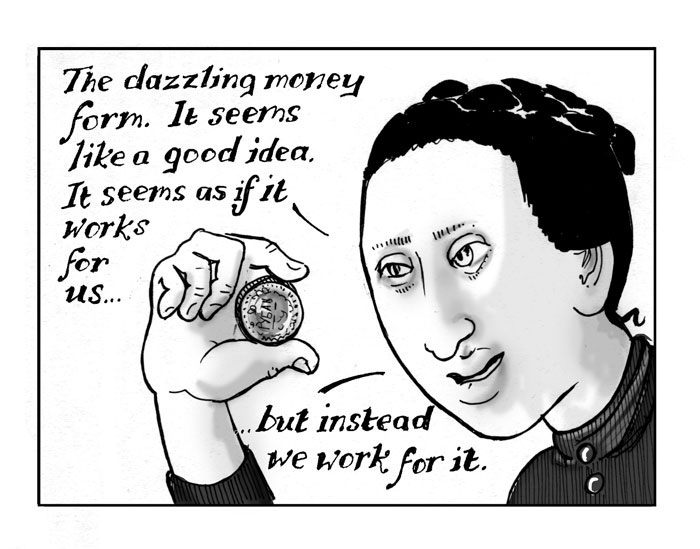
This graphic novel biography of socialist revolutionary Rosa Luxemburg was one of many Christmas gifts from Geoff. My first impression was that, with its historical background and its extensive end notes providing context on an almost page-by-page basis, it seemed reminiscent to me of Chester Brown's comic biography of Louis Riel.

From an artistic perspective, I was not surprised to learn that Kate Evans was solicited to create this text, and had not previously even heard of Rosa Luxemburg. Nor had I, so I am not critiquing ignorance. There is simply something about the artistic rendition of a text when it appears to be a passion project borne of genuine interest and the absolute need to tell a story that differs from one crafted because one has been commissioned. Some aspects appear to be included, despite artistic difficulties, because it would not be sensible without. I feel that this is reflected in the excess of words over images, the plain backgrounds, the tendency of certain faces to feel inconsistent, the forewarned conflation of characters, and what must be the author's predisposition toward visual imagery - no matter how trite the metaphor needs to be to suit the narrative.

That being said, as I will detail later, some of the visual imagery is necessary and helps to illuminate very complex topics. Also, some pages are exceptionally beautiful, which seems to me (incorrect as I could be) to illustrate the moments in Luxemburg's life that must have most resonated with Evans. For instance, scenes of imprisonment where Luxemburg pens many gorgeous, poetic letters about nature and wildlife are represented as equally aesthetically in text and image. Moreover, most notably, the scenes of Luxemburg's capture and untimely murder are as profound visually as textually.

I appreciate this graphic novel most on an historical level, for how simply it could represent Marxist ideas I have read in Capital. Also, I tend to understand much better through the use of visuals and tangible examples. As such, Red Rosa is a valuable complement to my reading of that text, and this is the focus on which I will choose to centre the rest of this post (hence the blog title), through a combination of words and images.

"'Rosa, what's the book about?'
'Das Kapital? Mm, interesting question. It's about things - about everything we have. Take this salt, for example. It has two properties. It has a use-value. I can use it. I can sprinkle it on my food... and it also has an exchange-value. Say I've had enough salt -- I don't want my food too salty -- I could take my salt and swap it with you for some pepper. Everything has a use-value and an exchange-value, but these intrinsic properties are mutually incompatible. [...] If I want to use my salt by eating it, then I can't exchange it with you. And if I want to exchange it, then I can't eat it.'
'Two sides of the same coin?'
'We're coming to coins in a minute. Different use-values have different qualities. We use salt for its saltiness and pepper for its pepperiness. Different exchange-values have different quantities. It doesn't matter what it is, only how much you have. If I had enough salt I could swap it for your pocket watch.'
'I'm not sure I want that much salt, Rosa.'
'Aha! That's where money comes in. Once money is involved, anything can be exchanged for anything and everything becomes a commodity. [...] I want a watch. Do you want a massive pile of salt?'
'No.'
'Oh. Now let's introduce money. [...] I'll sell my salt to someone else. Would you like to buy some salt?'
'Yes. I'll give you one gold coin for it.'
'How much for the watch?'
'One gold coin.'
'Here it is.'
 

"'Here is Marx's phrase: We have "material relations between persons and social relations between things." We treat objects like people. We desire them. We fetishise them. We treat them as valuable. We expect them to make us happy. [...] We treat people like objects. A person isn't a person anymore. He's a jeweller... or a miner... or a beggar... or a boss. It's money that makes inequality possible. In fact, it makes it inevitable. I have a lovely bowl of soup. Look! There's a starving person -- that's their fault for not having enough money -- they should work harder. [...] Once money is involved, people can exchange goods in order to make more money. This guy bought my salt not because he wanted salt, but so he could sell it again... for profit. Money is power -- it really is. It's the embodiment of all the effort that all the people put into making all those things. And now one person owns it. And he wants more. He can't really make money by buying and selling things -- sometimes he'd win and sometimes he'd lose. There's only one commodity he can buy that always creates a profit. Human labour power.'"
"'Those eight kopeks of surplus value are unpaid labour. It's exploitation. Slavery. That's what capital is. Poor worker spoons. Your jobs are so boring. Instead of skilled trades and crafts, you're doing shift-work, night-work, piece-work. You'll die young from overwork and you'll die poor. But look! There are so many of you! You can join together, realize your strength and overthrow your oppressors! And this is how capitalism will crumble!'" (Evans 17-22)

"One of the strengths of Marxist analysis is that it recognizes the contradictions inherent in complex systems. Marx took Hegel's theory of dialectics -- the idea that everything contains its opposite -- and applied it to the world around us. One cannot have light without dark. There cannot be a bourgeoisie without a proletariat to break its back. And most importantly, and fundamentally, capitalism creates the forces that tend toward its own destruction. As of a result of its own inner contradictions, capitalism moves towards a point when it will be unbalanced, when it will become simply impossible. (History has not yet proven the validity of this theory. That doesn't mean it isn't true.) This isn't just because building factories brings the workers together so that they recognize their common class interest and start to resist exploitation. It is inherent within capitalist economics. The continual pursuit of profit is, by definition, unsustainable. The quest for surplus value runs away from itself and the system swings from boom to bust. Fueled by the progressive socialisation of the process of production, the growing class consciousness of the proletariat, and the ungovernable chaos of the capitalist economy, the market outlet will begin to shrink because the world market has been extended to its limit and has been exhausted by the competition of capitalist countries. Sooner or later, this is bound to occur." (54-5)

"'Let us examine the ancient German village commune. For whom does this labourer work?'
'Himself.'
'Yes. This corn, these geese, these shoes -- are they commodities?'
'No, they are neither bought nor sold.'
'Exactly. They are made for the people, by the people.'
'One cannot imagine something simpler and more harmonious than this, the life of the so-called primitive. The immediate needs of everyday life and the equal fulfillment of everyone -- this is the starting point and endpoint of the economic system. Everyone works for everyone else and collectively decides on everything. Why? Because we have communism of the land and the soil. The common possession of the means of production on the part of those who work. Urkommunism truly is a global form of production. One can find examples of it on every inhabited continent.'" (95)

"'The same village, but now we see it in modern times. Common property ceases to exist, and, along with it, the common labour and common will that regulates this. We have the money economy. All interactions are based upon exchange. What does this mean? Each person is now on his own: the farmer, the shoemaker, the gooseherd, etc. The community no longer has anything to say to him, no one can order him to work for the whole, nor does anyone bother about his needs. Each person's share of the social labour is dictated by the market. Whatever he can sell, he labours at. Whether he can sell it determines whether he is rewarded. If he is lucky he can buy dinner. If not, he can go hang himself, for all society cares. Social wealth is no longer distributed according to need. It matters not to the market whether the labourer has two mouths to feed, or ten.'"


"'Perhaps you will ask, is not submission to the vagaries of the market a small price to pay for individual freedom? Alas, how unfree is this worker here. The distinctive feature of capitalism is the precariousness of the worker. The capitalist controls the means of production. The worker has nothing. The only commodity he can sell is his labour power... and the entire process revolves around the exploitation of that labour. The worker may think himself free. But what choice does he have other than to sell his labour? Jobs are scarce and insecure, for the capitalist keeps a reserve army of the unemployed ready at his bidding. The capitalist certainly considers himself free. But what other choice does he have but to press his workforce ever harder, driving up his profit? For if he doesn't swim ahead of the competition he will sink. All humanity groans with frightful suffering under the yoke of a blind social power, capital, that it has itself unconsciously created. The underlying purpose of every social reform of production, the satisfaction of society's needs, is turned completely on its head. Production is no longer for the sake of the people. Production for the sake of profit becomes the law all over the earth.'" (97-8)

"'Imagine a world where capitalism is complete. This is what Marx envisaged when writing Kapital: "treat the whole world as one nation and assume that the capitalism is everywhere established." So, everyone is a worker or a boss. The bosses own the means of production and employ workers, from whom they extort an ever-increasing amount of surplus-value, who produce commodities which must be sold and the resulting profits reinvested in the process. The accumulation of capital. That is the aim of the game. But, in order for this to take place, an ever-increasing supply of products must be sold to an ever-expanding market of consumers. There must be a demand for the product. But from whom? Who buys these goods? It is not the workers who consume the commodities, for they barely earn enough to keep body and soul together. The capitalist class, when viewed as a single entity, cannot buy up all the surplus produce, for to do so would be to squander the profit. "Aha!" You may reply, "In our society, not everyone is a worker or a boss. We have other occupations: poet, parson, prostitute. These people buy the products." But from whence do they obtain their income? From tending to the workers and the bosses. They are parasitic upon the capitalist process. They have no income that is independent from it.'" (100-1)

"'New Year's Resolution?'
'You know as well as I do, Leo. History is not making things easy for us. A bourgeois revolution could simply overthrow the official power and replace it with a couple of new men. But we must work from the bottom to the top. We can only come to power with the clear and explicit will of the great majority of the proletarian masses. Who knows how long that will take? And what does that matter, so long as our lives are long enough to bring it about?'"

---


I am reminded in that last quotation, of both Orwell's 1984 ("'If there is hope,' wrote Winston, 'It lies in the proles') and anti-Nazi activist Sophie Scholl of the White Rose, only 21 years old, who on her day of execution for high treason due to distributing political pamphlets, said: "How can we expect righteousness to prevail when there is hardly anyone willing to give himself up individually to a righteous cause? Such a fine, sunny day, and I have to go, but what does my death matter, if through us, thousands of people are awakened and stirred to action?"

These are strange times. I am reminded of my Grade 11 Ancient Civilizations teacher, who used to talk about tempocentrism, or the idea that every successive generation believes itself to be at the pinnacle of human and technological development. I thought us to be beyond a world where leftist ideas are dangerously radical - where people are persecuted for desiring equality in a world system that wants anything otherwise. These times feel less safe. This feels like a regression.

I've been reading more articles about revolution.

Saturday, January 7, 2017

Completed: #14. have a formal dress party

This formal dress party happened last night - which also served as a very belated housewarming party - and was a nice and active end to an otherwise reasonably quiet and relaxed holiday break.


Sunday, January 1, 2017

Progress: 16/30 - #18. read 30 texts that will aid in my teaching


I discovered this Canadian Métis poet while looking for a poem about the medicine wheel, in order to introduce the concept to my grade 10s. I downloaded a small sample set of poems first, stumbling upon this gorgeous piece, to which I knew my parents would relate:


This was enough exposure for me to seek out the entire anthology, which I could find only in used form, from Amazon. It came in pristine condition, signed by the author, to "Beverly". Published in 1993, it's sadly unsurprising to me that this anthology was met with substantially less exposure than I wager it would be were it released today. It deals with issues of alcoholism, recovery, poverty, domestic violence, indigenous rights, and a sense of being "caught between cultures". With a melodic yet prosaic cadence, and abstract but visceral imagery, it's easily accessible. It is divided into medicine wheel directions, cut in four by illustrations of stones.

The combination of a few things has left me inevitably reflective: 1. the new year, 2. reading Wasted (see previous entry), 3. the quiet time away from the world. Though met with sometime tears and not-always-comfortable revelations, it hasn't felt as empty and longing a process as usual - more, finally, constructive, putting fears and resolutions to spoken word, and entertaining possibilities for release.

It's all in answering the whys.

"Because I miss being smart," I cry. "I miss being impressive. I miss my life meaning something. I miss feeling, like I did when I was 17, that I was destined to do something important."

Geoff asks: "What would you do?"

"I would write. I would maybe have a PhD."

"What would you write?"

"I would write poetry. I would write a graphic novel."


I will read more of both. I will write and I will draw and I will seek out opportunities.

York U offers a part-time PhD program in Education, too. My limits are only stopping myself from seeking whatever it is I wish to find.


I woke up this morning.

I smudged for the first time in too long.

I finished reading this beautiful poetry anthology.

Happy new year.


Smudge Ceremony 

A Spider's Delicate Work

by: Gregory Scofield

A spider's delicate work     hangs in mind     an endless
thread     weaving me into his sticky tapestry     unravels
my dreams      shamelessly

crawl back into my abalone smudge bowl
sage smoke going up high
summons an eagle circling
circling
hands through smoke wash head
face
shoulders
back
stomach
legs
feet

purified     ready to chase him
under his own black creation

Friday, December 30, 2016

Progress: 15/30 - #18. read 30 texts that will aid in my teaching


I've avoided this memoir for a very long time, out of some deep-seated fear. I just read it, in the better part of two days. Most of this post will be in the form of chosen quotations, as they are both integral to understanding this text and more coherent than any of my "words in review" would be.  

Two small interpretations:

1. It is quite noticeable and notable to me that (in contrast to the rest of the memoir) she does not name any of the people by whom she is surrounded, in her residence and classes, in her most severe year of sickness - denoting only an anorectic's capability for extreme distancing and her inability here to make friends.

2. There is a notable difference in the content and tone of the afterward from the original edition, in 1998 (where she speaks of still being underweight and having forever one foot in and one foot outside the rabbit hole mirror), to the updated afterward from 2014 (where she writes, point-blank: "If this illness feels right now like a cage, please try to hear me: it isn't locked. It has been open all along. You are free to go." (Hornbacher 301) ) I want to know what the difference has been, besides 16 years. When she talks about "full recovery, the real thing, not that wan, halfway, half-assed recovery many of us have been told was the best we could hope to achieve" (300), how did she get from the 1998 edition to here? She is an active Facebooker, even with her fans, and I think of messaging her to ask this very question - but I think her individual answer is in here, too: something about the giving oneself the permission to live and to let go. I suppose you have to figure out, first, how to want to let go.


-----


"I have never been normal about my body. It has always seemed to me a strange and foreign entity. I don't know if there was ever a time when I was not conscious of it. As far back as I can think, I was aware of my corporeality, my physical imposition on space." (13)

"Eating disorders are addictions. You become addicted to a number of their effects. The two most basic and important: the pure adrenaline that kicks in when you're starving - you're high as a kite, sleepless, full of a frenetic, unstable energy - and the heightened intensity of experience that eating disorders initially induce. At first, everything tastes and smells intense, tactile experience is intense, your own drive and energy themselves are intense and focused. Your sense of power is very, very intense. You are not aware, however, that you are quickly becoming addicted." (105)

"I was on a mission to be another sort of person, a person whose passions were ascetic rather than hedonistic, who would Make It, whose drive and ambition were focused and pure, whose body came second, always, to her mind and to her 'art'. I had no patience for my body. I wanted it to go away so that I could be a pure mind, a walking brain, admired and acclaimed for my incredible self-control" (107-8).

"You begin to rely on the feeling of hunger, your body's raucous rebellion at the small tortures of your own hands. When you eventually begin to get well, health will feel wrong, it will make you dizzy, it will confuse you, you will get sick again because sick is what you know. I cannot explain why I remember this year with such joy. Perhaps it is because it was just the beginning." (111)

"People have this idea that eating-disordered people just don't eat. Wrong. They have rules about what they eat, and eat 'safe foods'" (113)

"People who've Been to Hell and Back develop a certain sort of self-righteousness. There is a tendency to say: I have an addictive personality, I am terribly sensitive, I'm touched with fire, I have Scars. There is a self-perpetuating belief that one simply cannot help it, and this is very dangerous. It becomes an identity in and of itself. It becomes its own religion, and you wait for salvation, and you wait, and wait, and wait, and do not save yourself. If you saved yourself and did not wait for salvation, you'd be self-sufficient. How dull." (131)

"The body, many of us find to our great dismay, will always win. Either it will survive despite our best efforts, dealing a blow to our egotistical notion that we can control it, or it will die, making emotional survival utterly moot." (134)

"But at the same time, physical contact has not come naturally to me. It seemed, and seems, laden with significance, so laden that one might like to avoid it altogether. One might, in fact, over a few years, begin to avoid it like the plague, begin to claim such absolute ownership over one's own body that contact itself - the brush of a hand, even, let alone the startling number of emotional and physical nerve endings jangled by an embrace - begins to seem a threat." (202)

"Self-mutilation. And he shook his head. I just don't understand that, he said. I understood. I understood so well, in fact, that I would begin to do that very thing a few years down the road. After my eating disorder was 'over', I would go in a blind search for something else with which to tear myself apart. I found a razor blade worked quite well. In Lowe House, what this girl was doing to herself made perfect sense to me. It seemed to me only that our means were different; our ends were very much the same. Carving away at the body to - symbolically and literally - carve up an imperfect soul." (206)

"In her presence, I was reminded again of why I was an anoretic: fear. Of my needs, for food, for sleep, for touch, for simple conversation, for human contact, for love. I was anoretic because I was afraid of being human. Implicit in human contact is the exposure of the self, the interaction of selves. The self I'd had, once upon a time, was too much. Now there was no self at all. I was a blank." (266)

"There is never a sudden revelation, a complete and tidy explanation for why it happened, or why it ends, or why you are who you are. You want one and I want one, but there isn't one. It comes in bits and pieces, and you stitch them together wherever they fit, and when you are done you hold yourself up and still there are holes and you are a ragdoll, invented, imperfect. And yet you are all that you have, so you must be enough. There is no other way." (279-280)

"There is a difficult factor in deciding to end the game, and that is that most women are playing it at some level of intensity or another - and all of those levels have sublevels of dangers, not just the over-the-top-mortality-stat type of disorder. Eating-disordered people, for the most part, don't talk to one another. It is usually not a little sorority where it's all done in a very companionable way. It's usually intensely private. And when you decide you are tired of being alone with your sickness, you go out seeking woman friends, people who you believe can show you by example how to eat, how to live - and you find that by and large most women are obsessed with their weight. It's a little discouraging." (282)

"I threw out my scale. When I bought another one, I threw that one out too. I kept doing this until the absurdity of it outstripped the anxiety I felt without having a way to measure something totally irrelevant. To this day, when I'm at the doctor, I stand on the scale backwards and ask the nurse not to tell me my weight. After all this time? Yes. It's habit by now. It's a good habit." (303)


Wednesday, December 28, 2016

Completed: #39. try embroidery

I find that I develop obsessions with certain arts or crafts for extended periods of time, and it gets difficult for me to focus on anything different - no matter how comparable a craft. Lately, that focus has been beadwork, which I have been using to my advantage in order to gift freehand medicine pouches for special occasions, and fashion treecycled Christmas ornaments in peyote stitch.


Sometimes, in order to try something new, I must actively remind myself that, whatever my current obsession, I once did not know how to do that either. It takes a lot of concerted work to convince myself. (True story, according to my mother's pen notations in my baby book: My first full sentence, at 14 months, while trying to count to 10 and say my ABCs, was "I can't do it." Therefore, I have to believe that my defeatist attitude is at least partially innate. However, having mastered both the alphabet and counting to 10, I have to remind myself that this attitude may also be inaccurate.)

SO. I finally convinced myself to pick up this beginner's embroidery kit, which my dear friend Steph gifted me an embarrassingly long time ago. For what it's worth, I never forgot. I've stared at it in my studio many times.


Evidently, my hoop is 2" too small, but it is all I have. No big deal. I figured if I can position and tighten it, I can untighten and reposition. It worked out fine.

Now, I was surprised to find that the enclosed instruction set didn't have diagrams on how to do the stitches (which I later found out are conveniently and environmentally-friendily located on the creator's web site), so I relied on some YouTube tutorials and internet photographs. Some I couldn't figure out, so I just improvised. Oops.

For instance, while attempting a chain stitch, I actually used a split stitch, because this small memory that was previously buried in my brainfolds, I guess, resurfaced to remind me: "Oh, hey, my mom once taught me something like this as a kid!" I remembered her drawing in chalk on taut fabric and instructing me on how to form letters with thread. I think I may have stitched "I love you" and given it to my dad for some sort of occasion.

Anyway. This is not a chain stitch, but it works:


I did newly teach myself those fly stitches, though. Those were kind of fun.

(Also, for reference, here is the kind of thing my mom has been capable of embroidering FOR DECADES:


This was a gift she made for my dad in the 1970s, which now - resulting from sizing and symbolic purposes - now belongs to me. The students love it because it's OMG SO VINTAGE, and that sort of thing is in now, y'know?

Maybe someday I will make something of this quality. That day is not today. Alas, I had to start somewhere.)


Now, at some point I ran out of the supplied embroidery thread, due to using double lines when I should have used single lines. Fortunately, along with a lot of I-swear-I'll-use-them-someday materials that I possess in my art studio, I had some thread of my own. I started using it, as a result, and was kind of pleased with the colour variation.

Here are the final photos:


C'est ça. Someday, I would like to embroider my own design, at least. Someday.